# Leaderboard
From the presale phase onward, each player in Olympic Fantasy game will be assigned to a specific tier based on the number of tokens they hold. These tiers are determined by our advanced algorithm to ensure a fair and balanced system, allowing players to compete against others within their respective leagues. Think of tiers as leagues for users within our fantasy game, but with additional benefits and rewards.
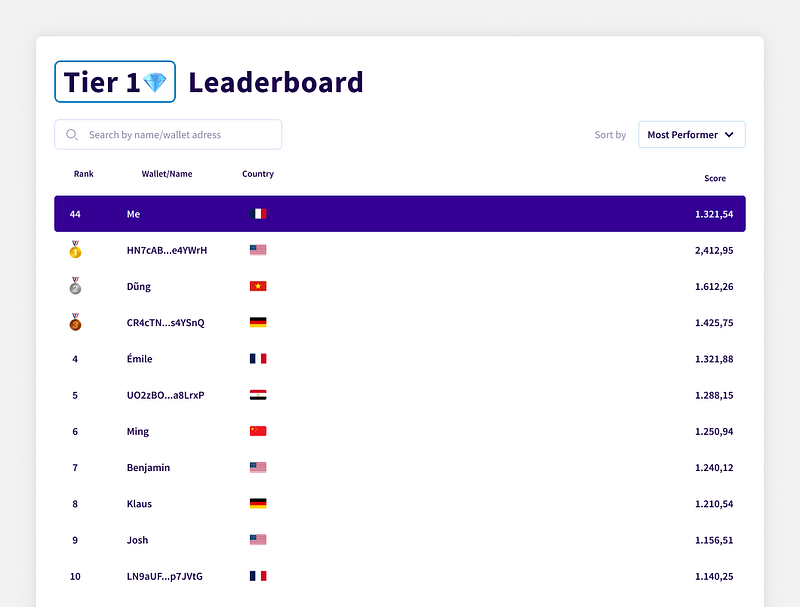
As the Olympic Games progress and points are awarded following each medal ceremony, a snapshot of the leaderboard will be taken. This snapshot will capture the standings of players within each tier at the end of the event. Rewards will then be distributed to the top players in each tier based on their final rankings.
Example of Leaderboards by Tiers
Each tier will have its own distinct leaderboard and prize distribution. The reward pool for each tier is proportional to its size, meaning that higher tiers with more significant participation will have larger prize pools. This structure ensures that all players, regardless of their tier, have a fair chance to compete for rewards. More details about the tier system and its benefits will be provided in the Presale section, offering further insights into how players can maximize their participation and rewards in $OLYFA’s fantasy Olympic game.
---
# Agent Instructions: Querying This Documentation
If you need additional information that is not directly available in this page, you can query the documentation dynamically by asking a question.
Perform an HTTP GET request on the current page URL with the `ask` query parameter:
```
GET https://olympicfantasysol.gitbook.io/solana-blockchain-based-fantasy-game/leaderboard.md?ask=
```
The question should be specific, self-contained, and written in natural language.
The response will contain a direct answer to the question and relevant excerpts and sources from the documentation.
Use this mechanism when the answer is not explicitly present in the current page, you need clarification or additional context, or you want to retrieve related documentation sections.